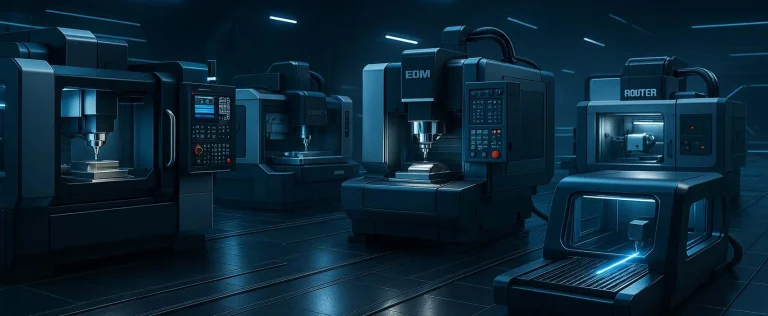
Specialized CNC Machines

Specialized CNC Machines are specially designed, computer-controlled machines for specific applications, which make production processes easier through precision and automation. They are normally employed for cutting wood, plastic or metal into particular designs, forms or shapes. Production time is reduced and efficiency enhanced.

Specialized CNC Machines: Complete Guide, Applications & Future

Why Modern Industries Can’t Run Without Specialized CNC Machines

Specialized CNC MachinesIn today’s industrial world, precision, efficiency, and automation are essential. Specialized CNC Machines are at the heart of manufacturing, enabling industries to produce highly complex parts with speed and accuracy. From aerospace components and automotive molds to medical devices and industrial machinery, these machines ensure consistent quality while reducing labor costs and material waste.

Traditional manual processes were slow, error-prone, and limited in complexity. Modern Specialized CNC Machines like 5-Axis CNC Machines, 7-Axis CNC Machines, Swiss-type CNC Lathes, and CNC Gear Hobbing Machines allow manufacturers to achieve levels of precision and productivity that were unimaginable a few decades ago.


Basics of Specialized CNC Machines

Specialized CNC Machines are computer-controlled systems designed to perform highly specific manufacturing tasks. While general CNC machines handle standard cutting, drilling, or milling, specialized machines are optimized for complex geometries, multi-axis movements, or unique material handling.

Timeline / History

  • Manual Era: Cutting, milling, and turning were done entirely by hand, relying on operator skill.

  • Mechanical Machines: Early motorized tools improved speed but lacked automation.

  • CNC Revolution: Computer Numerical Control enabled automation, high precision, and repeatability.

  • Modern Specialization: Today’s machines, including 5-axis and 7-axis CNC systems, Swiss-type lathes, and gear hobbing machines, are highly specialized for complex manufacturing needs.


Working Principle

At the core, Specialized CNC Machines operate by following pre-programmed designs (G-code or CAM files), controlling tools along multiple axes with extreme accuracy.

Analogy: Imagine cutting a paper with scissors versus sculpting a steel component with a 5-axis CNC machine—the precision, speed, and repeatability are in entirely different leagues.

Motors (servo or stepper), hydraulic systems, and software-controlled tool paths coordinate to produce intricate shapes. Depending on the machine, operations may include:

  • Multi-axis milling or turning

  • Gear cutting or hobbing

  • Pipe bending and forming

  • Coil winding and spring forming


Types of Fabrication & Punching Machines

1. 5-Axis CNC Machines

5-Axis CNC Machines are advanced systems capable of moving a cutting tool or workpiece along five axes simultaneously. This enables highly complex 3D cuts in a single setup, which reduces multiple repositioning, improves accuracy, and increases efficiency. These machines are ideal for intricate parts requiring simultaneous contouring and milling.
Applications: Aerospace components, automotive molds, medical implants, complex industrial parts
Features: High precision (±0.01 mm), smooth surface finish, automated tool changes, compatibility with hard metals and composites
🔗 Learn more: 5-Axis CNC Machine

2. 7-Axis CNC Machines

7-Axis CNC Machines expand on the capabilities of 5-axis machines by providing additional rotational movements. This is particularly useful for extremely complex geometries and multi-faceted parts that require minimal repositioning. These machines excel in industries where tight tolerances and complex designs are mandatory.
Applications: Medical devices, aerospace prototypes, high-precision molds, robotics components
Features: Reduced setup time, enhanced surface finish, ability to work on intricate contours, automation-friendly
🔗 Explore: 7-Axis CNC Machine

3. Swiss-type CNC Lathes

Swiss-type CNC Lathes specialize in producing long, slender, and highly precise components with minimal runout. These machines are perfect for small-diameter parts requiring tight tolerances, such as screws, pins, and electronic components. They feature guide bushing support for better stability and can perform simultaneous turning, milling, and drilling operations.
Applications: Medical implants, watches, electronics connectors, precision screws, aerospace components
Features: High repeatability, multi-tool capability, automated bar feeding, minimal vibration
🔗 Details: Swiss-type CNC Lathe

4. CNC Gear Hobbing Machines

CNC Gear Hobbing Machines are used for cutting gears with high precision and repeatability. They can produce spur, helical, bevel, and worm gears depending on tooling and programming. Modern CNC hobbing machines allow quick setup changes, efficient material removal, and tight tolerance control.
Applications: Automotive gearboxes, industrial machinery, robotics, aerospace transmission systems
Features: High accuracy, programmable feed rates, automatic lubrication, multi-axis gear cutting
🔗 Check here: CNC Gear Hobbing Machine

5. CNC Pipe Bending Machines

CNC Pipe Bending Machines automate the bending of pipes and tubes with high precision and minimal deformation. With programmable angles and multiple bending axes, these machines handle complex pipe layouts for industrial, automotive, and aerospace applications. CNC control ensures consistent radius and bend quality, reducing scrap and setup times.
Applications: Automotive exhausts, aerospace piping, industrial tubing, furniture frames
Features: Multi-axis bending, high repeatability, automatic angle compensation, minimal distortion
🔗 Learn more: CNC Pipe Bending Machine

6. CNC Coil Winding Machines

CNC Coil Winding Machines automate the winding of coils for motors, transformers, and sensors. These machines allow precise control over turns, tension, and winding speed, ensuring uniformity and reducing human error. Programmable sequences make them ideal for both prototype and high-volume production.
Applications: Electric motors, transformers, inductors, sensors, R&D prototypes
Features: High repeatability, tension control, programmable winding patterns, multi-layer winding capability
🔗 Explore: CNC Coil Winding Machine

7. CNC Spring Forming Machines

CNC Spring Forming Machines automate the production of torsion, compression, and tension springs. These machines allow programmable coil pitch, diameter, and length, ensuring consistent performance across batches. Advanced systems can handle complex spring geometries that would be difficult or impossible manually.
Applications: Automotive suspension, electronics, industrial machinery, aerospace components
Features: High precision, multi-axis forming, automatic wire feeding, minimal material waste
🔗 Details: CNC Spring Forming Machine


Key Components of Specialized CNC Machines

  • CNC Control Unit: Executes programmed operations with high accuracy, ensuring consistent and repeatable results.

  • Hydraulic & Servo Systems: Deliver precise movement and force for complex operations.

  • Tooling: Includes punches, dies, blades, bending tools, and other specialized attachments.

  • Workholding & Safety Systems: Secure materials firmly and protect operators during high-speed operations.


Materials Processed

  • Metals: Steel, aluminum, brass, copper

  • Composites: Laminates, carbon fiber panels

  • Sheet Thickness: 0.5mm – 25mm+ depending on machine capacity and type


Applications

Automotive Industry: Body panels, chassis components, brackets, decorative trims
Aerospace: Fuselage panels, structural parts, high-precision brackets
Shipbuilding: Hull sections, decks, interior panels, decorative structures
Electrical & Electronics: Enclosures, front panels, connectors, precision housings
Furniture & Interior Design: Frames, metal panels, decorative sheets, customized interiors
Small Workshops: Rapid prototyping, small-batch production, customized components


Advantages

  • Exceptional precision and repeatability across complex parts

  • Faster production speeds, reducing labor requirements

  • Cost efficiency through minimized material waste

  • Enhanced operator safety due to automated systems

  • High versatility, capable of processing metals, composites, and specialty materials


Limitations & Challenges

  • High initial investment costs for advanced models

  • Requirement for skilled operators → potential future skill gap

  • Ongoing maintenance and tooling expenses

  • Energy consumption depending on machine size and complexity


Safety Standards & Best Practices

  • Wear appropriate PPE: gloves, goggles, masks

  • Use machine guards and emergency stop systems

  • Follow standardized CNC safety protocols

  • Conduct regular preventive maintenance and inspection


Future Trends

  • Smart Factories & Automation: IoT-enabled monitoring and remote control

  • Digital Twin Integration: Simulate and optimize operations digitally

  • Sustainable Manufacturing: Energy-efficient and low-waste production

  • AI-driven Optimization: Adaptive cutting, punching, bending, and forming


Buying Guide

  • Evaluate production requirements: volume, material type, and part complexity

  • Check machine capacity and tonnage

  • Ensure tooling and software compatibility

  • Verify after-sales support and warranty coverage


Cost Factors

  • Machine prices: $15,000 – $200,000+ depending on specialization

  • Tooling, maintenance, and replacement costs

  • Energy consumption for high-volume or complex operations


Conclusion

Specialized CNC Machines are the backbone of modern industry. From CNC Punching Machines, Press Brakes, and Shearing Machines to advanced 5/7-Axis CNC systems, Swiss-type lathes, Coil Winding Machines, and Spring Forming Machines, these tools enable manufacturers to achieve unmatched precision, efficiency, and productivity. Incorporating Specialized CNC Machines is no longer optional—it is essential for industries aiming to stay competitive, reduce waste, and deliver high-quality products consistently.

👉 Explore More Insights on My CNC Line Blog

📚 Specialized CNC Machines FAQs

Q No Question Answer
Q1 How long does a CNC tool last? Typically several weeks to months depending on material and usage.
Q2 Can Swiss-type CNC lathes produce miniature parts? Yes, with high precision and minimal runout.
Q3 What thickness can CNC pipe bending machines handle? Usually 1mm – 20mm depending on machine capacity.
Q4 Are 5-axis CNC machines suitable for aerospace parts? Absolutely, for complex 3D geometries with tight tolerances.
Q5 Can CNC gear hobbing machines produce helical gears? Yes, with proper programming and tooling.
Q6 Are CNC coil winding machines good for prototyping? Yes, they provide repeatable results for prototypes.
Q7 How safe are CNC spring forming machines? Very safe with PPE, guards, and emergency stops.
Q8 Do 7-axis CNC machines reduce setup time? Yes, they minimize repositioning for complex parts.
Q9 Can CNC machines work with composites? Yes, specialized CNC machines handle laminates and carbon fiber panels.
Q10 Is maintenance difficult for specialized CNC machines? Routine maintenance is required but ensures high performance and longevity.
Q11 What industries benefit most from specialized CNC machines? Aerospace, automotive, medical, electronics, shipbuilding, and furniture manufacturing.
Q12 Can CNC pipe bending machines handle stainless steel? Yes, with appropriate tooling and settings.
Q13 Are CNC gear hobbing machines suitable for robotics components? Absolutely, for high-precision gears.
Q14 How energy-intensive are these machines? Energy consumption varies by size, type, and material.
Q15 Do specialized CNC machines require software? Yes, CNC machines require CAM/CAD software for programming, toolpath creation, and precise operations.