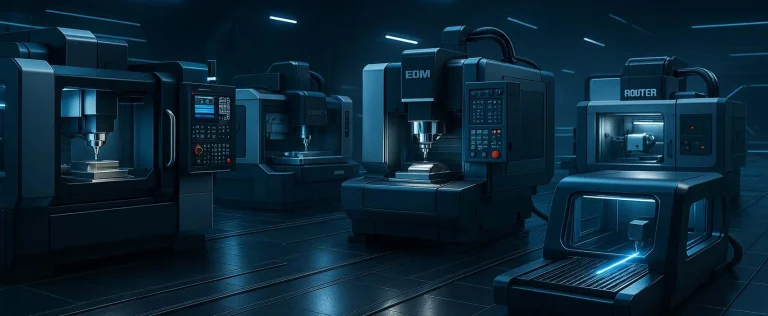
CNC Turning Center: Superior Performance, Precision, and Applications

In today’s fast-paced world of manufacturing, CNC Turning Centers stand out as one of the most advanced and versatile machining solutions. Whether you are in automotive, aerospace, medical device manufacturing, or general engineering, these machines deliver unmatched accuracy, consistency, and efficiency. Let’s dive deep into what makes CNC Turning Centers superior, their types, working principles, applications, benefits, and why they remain an essential part of modern industry.


What is a CNC Turning Center?

A CNC Turning Center is an advanced version of the traditional lathe machine, designed for high-precision and high-volume production. Unlike basic CNC lathes, turning centers often feature multi-axis capabilities (up to 5-axis), automated tool changers, and live tooling for milling, drilling, and tapping operations. This means they can handle more complex geometries and reduce the need for multiple setups.

In simple terms, while a CNC lathe rotates the workpiece against a cutting tool, a CNC Turning Center is like an upgraded factory-in-one, performing multiple machining operations with greater automation and efficiency.


Types of CNC Turning Centers

CNC Turning Centers come in various configurations, each suited for specific tasks. The most common types include:

1. Horizontal Turning Center

  • The most widely used type.

  • Workpiece is mounted horizontally.

  • Ideal for cylindrical parts like shafts, pipes, and automotive components.

2. Vertical Turning Center (VTL)

  • Workpiece is mounted vertically.

  • Perfect for handling large, heavy, and wide-diameter components (e.g., turbine housings, gear blanks).

3. Twin-Spindle Turning Center

  • Equipped with two spindles.

  • Allows machining on both sides of a part without manual intervention.

  • Boosts productivity and reduces cycle time.

4. Multi-Turret Turning Center

  • Uses multiple turrets with cutting tools.

  • Can perform several operations simultaneously.

  • Great for mass production with faster throughput.

5. Swiss-Type CNC Turning Center

  • Specialized for small, highly precise parts.

  • Common in medical, electronics, and watchmaking industries.


Working Principle of a CNC Turning Center

At its core, the working principle of a CNC Turning Center revolves around rotational cutting. Here’s how it works step by step:

  1. Workpiece Loading – The raw material (often a cylindrical bar) is loaded into the spindle chuck.

  2. Spindle Rotation – The spindle rotates the workpiece at high speed.

  3. Tool Engagement – CNC-controlled cutting tools move linearly or radially to remove material.

  4. Multi-Axis Machining – Advanced turning centers can use Y-axis, C-axis, or B-axis to perform milling, drilling, and tapping.

  5. Automation – Many machines are equipped with robotic arms or bar feeders to automate loading/unloading.

  6. Precision Output – Finished parts come out with micron-level tolerances, reducing the need for secondary finishing operations.


Applications of CNC Turning Centers

CNC Turning Centers are used in almost every manufacturing sector. Some key applications include:

  • Automotive Industry – Engine parts, transmission shafts, brake components.

  • Aerospace – Landing gear parts, turbine components, structural fittings.

  • Medical Field – Surgical instruments, orthopedic implants, dental devices.

  • Oil & Gas – Pipe fittings, valves, drilling equipment.

  • Electronics – Connectors, housings, precision pins.

  • Defense Industry – Weapon components, aerospace-grade parts.

  • General Engineering – Fasteners, pulleys, bushings, and couplings.


Benefits of CNC Turning Centers

Why are CNC Turning Centers so popular worldwide? Here are some of their top benefits:

  1. Superior Precision – Achieves tolerances within microns.

  2. High Productivity – Multi-axis operations reduce setup time.

  3. Automation – Minimizes manual labor and errors.

  4. Versatility – Can handle simple to complex parts in one setup.

  5. Consistency – Produces identical parts even in mass production.

  6. Time-Saving – Faster machining speeds and reduced downtime.

  7. Cost-Efficient – Lower scrap rates and optimized material usage.

  8. Safety – Fully enclosed machines protect operators.

  9. Scalability – From prototypes to high-volume production runs.

  10. Advanced Integration – Compatible with CAD/CAM systems for smart manufacturing.

Bottom Line

The CNC Turning Center is more than just a machining tool — it is the heart of modern manufacturing. From small precision parts to massive aerospace components, these machines ensure superior performance, unmatched precision, and wide-ranging applications. With benefits like automation, versatility, and cost-efficiency, CNC Turning Centers continue to be the backbone of industries worldwide.

For manufacturers aiming to stay ahead in today’s competitive global market, investing in a CNC Turning Center is not just a choice — it’s a necessity.

📚 CNC Turning Center FAQ

Q No Question Answer
Q1 What is the difference between a CNC lathe and a CNC Turning Center? A CNC lathe is simpler and mainly used for turning, while a CNC Turning Center is more advanced with milling, drilling, and multi-axis features.
Q2 Which industries use CNC Turning Centers the most? Automotive, aerospace, medical, oil & gas, and electronics industries are top users.
Q3 Are CNC Turning Centers expensive? Yes, initial investment is high, but long-term productivity and precision make them cost-effective.
Q4 What materials can be machined with a CNC Turning Center? Steel, aluminum, titanium, brass, copper, plastics, and composites.
Q5 What is the typical lifespan of a CNC Turning Center? With proper maintenance, 10–20 years of efficient operation is common.
Q6 Do they require skilled operators? Yes, operators must understand CNC programming, but automation reduces manual complexity.
Q7 Can CNC Turning Centers handle both small and large parts? Yes, depending on machine size — from micro parts (Swiss-type) to heavy components (VTLs).
Q8 How accurate are CNC Turning Centers? They can achieve tolerances as tight as ±0.005 mm.
Q9 Is it possible to automate CNC Turning Centers? Absolutely. Many are integrated with robotic arms, bar feeders, and IoT systems.
Q10 What is the difference between horizontal and vertical turning centers? Horizontal is best for long cylindrical parts, while vertical handles large-diameter heavy parts.
Q11 Do CNC Turning Centers support CAD/CAM integration? Yes, most modern systems are fully compatible with CAD/CAM for design-to-production workflow.
Q12 What are the maintenance needs? Regular lubrication, spindle checks, tool calibration, and software updates ensure longevity.

Leave a Reply

Your email address will not be published. Required fields are marked *