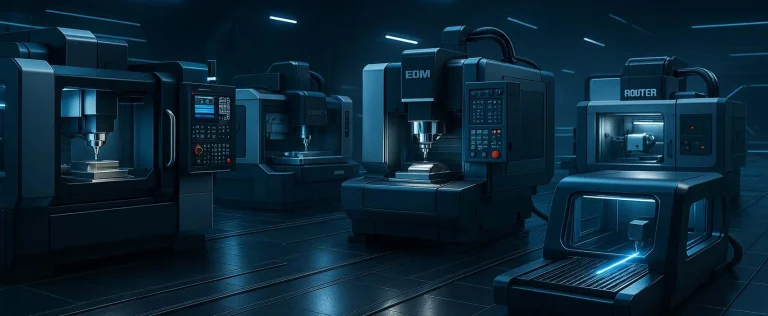
Cutting & Shaping Machines
Machines and forming machines are used in the production of iron, a material such as metal, wood, or art in the desired shape to cut and bring. Examples include turning machines, cutting machines, and cutting machines. These machines demonstrate precision, save time, and boost productivity in industrial processes.
Cutting & Shaping Machines: Complete Guide
Introduction
Imagine building a car where every part must fit with absolute precision. If a shaft is even one millimeter off, the whole system can fail. That’s why Cutting & Shaping Machines are the backbone of modern manufacturing.
But today, these machines are no longer just manual tools operated by hand. With the rise of CNC (Computer Numerical Control), cutting and shaping have transformed into highly automated, accurate, and efficient processes.
In this guide, we’ll cover:
What cutting & shaping machines are.
The 8 key types of CNC machines (Lathe, Milling, Turning Center, Drilling, Boring, Grinding, Honing, Broaching).
Applications across industries.
Advantages, challenges, and future trends.
What are Cutting & Shaping Machines?
Cutting & Shaping Machines are used to remove material and give workpieces their desired shape.
Cutting Machines → Focus on removing material (e.g., drilling, milling, grinding).
Shaping Machines → Focus on forming the material into specific shapes (e.g., turning, broaching).
When integrated with CNC technology, these machines achieve:
✔️ Unmatched accuracy
✔️ Faster production cycles
✔️ Consistent quality
✔️ Reduced human error
Types of CNC Cutting & Shaping Machines
1. CNC Lathe Machine
The CNC Lathe Machine is often considered the foundation of machining. Traditionally, lathes shaped wood and metal manually. Today, CNC lathes produce shafts, screws, bolts, and cylindrical parts with high precision.
👉 Read the full guide here: CNC Lathe Machine
2. CNC Milling Machine
Think of the CNC Milling Machine as the all-rounder. It doesn’t just cut—it can drill, slot, contour, and shape complex designs. That’s why it’s heavily used in automotive, aerospace, and medical device manufacturing.
👉 Explore more in: CNC Milling Machine
3. CNC Turning Center
A CNC Turning Center is like the advanced version of a lathe. Unlike a simple lathe, it can handle turning, drilling, threading, and tapping in a single setup. This saves time and boosts productivity.
👉 Learn more: CNC Turning Center
4. CNC Drilling Machine
We’ve all seen handheld drills, but CNC Drilling Machines are a different story. They can produce thousands of perfectly aligned holes in aircraft frames, engines, and electronic components—faster and more accurately than any human could.
👉 Detailed insights: CNC Drilling Machine
5. CNC Boring Machine
Where drilling creates holes, the CNC Boring Machine makes those holes larger and more precise. It’s especially vital in heavy industries, such as engine blocks or turbine housings.
👉 Full guide here: CNC Boring Machine
6. CNC Grinding Machine
Grinding is all about the finishing touch. A CNC Grinding Machine removes the smallest imperfections, leaving behind smooth, high-precision surfaces. It’s essential in tool and die making.
👉 Read more: CNC Grinding Machine
7. CNC Honing Machine
If grinding focuses on outer surfaces, CNC Honing Machines perfect the inner ones. They are critical for engine cylinders, hydraulic pipes, and medical equipment, where internal finishing must be flawless.
👉 Explore details: CNC Honing Machine
8. CNC Broaching Machine
CNC Broaching Machines are specialists. They cut keyways, splines, and gear teeth quickly and efficiently, making them ideal for automotive and heavy equipment industries.
👉 Discover more: CNC Broaching Machine
Applications of CNC Cutting & Shaping Machines
Automotive → Shafts, gears, engine parts
Aerospace → Blades, frames, turbine parts
Medical → Surgical instruments, bone implants
Tool & Die Making → Precision molds and dies
Workshops → Prototypes and custom components
Advantages of CNC Cutting & Shaping Machines
Extreme precision and repeatability
Faster cycle times and production scalability
Can handle complex geometries
Reduces human errors
Long-term cost efficiency through automation
Challenges & Limitations
High upfront investment cost
Requires skilled programmers and operators
Maintenance and software upgrades are expensive
Future Trends
AI + IoT Integration for smart monitoring
Hybrid CNC Machines (CNC + 3D Printing)
Robotics & lights-out manufacturing (machines running without supervision)
More eco-friendly, energy-efficient designs
Conclusion
CNC Cutting & Shaping Machines are no longer optional—they are the backbone of modern manufacturing. Each machine—whether it’s a lathe, milling, or broaching system—plays a unique role in ensuring speed, precision, and quality.
👉 To explore each machine in detail, check our dedicated articles on:
📚 FAQs About CNC Cutting & Shaping Machines
| Q No | Question | Answer |
|---|---|---|
| Q1 | What is the difference between cutting and shaping machines? | Cutting removes material, while shaping gives the workpiece a specific form. |
| Q2 | Which industries use CNC cutting & shaping machines? | Automotive, aerospace, medical, tool-making, and even small workshops. |
| Q3 | What makes a CNC Lathe different from a Turning Center? | Turning Centers can perform multiple operations beyond simple turning. |
| Q4 | What materials can CNC machines work on? | Metals, plastics, composites, wood, and ceramics. |
| Q5 | How accurate are CNC machines? | They can achieve tolerances as tight as ±0.001 mm. |
| Q6 | What is the cost of a CNC machine? | Anywhere from $30,000 to several hundred thousand dollars. |
| Q7 | Do CNC machines require skilled operators? | Yes. While automated, they need skilled setup and programming. |
| Q8 | How long do CNC machines last? | With proper care, 10–20 years. |
| Q9 | What software do CNC machines use? | CAD for design and CAM for manufacturing instructions. |
| Q10 | How is grinding different from honing? | Grinding focuses on external surface finishing, honing improves internal surfaces. |
| Q11 | Why is CNC milling so versatile? | Because it can cut, drill, slot, and create complex shapes. |
| Q12 | Can small workshops use CNC drilling machines? | Yes, compact versions are available for small businesses. |
| Q13 | What is broaching mainly used for? | Cutting keyways, splines, and gear teeth with accuracy. |
| Q14 | Can CNC machines run unsupervised? | Yes, many support “lights-out” manufacturing. |
| Q15 | What abrasives are used in honing? | Diamond or ceramic stones are common. |
| Q16 | Are CNC machines environmentally friendly? | Yes, they reduce material waste and optimize energy usage. |
| Q17 | What’s the future of CNC technology? | AI-driven smart factories with robotics integration. |
| Q18 | How fast can CNC machines cut? | Advanced machines cut hundreds of parts per hour. |
| Q19 | What’s the difference between boring and drilling? | Drilling makes new holes, boring enlarges and refines them. |
| Q20 | Can CNC machines be customized? | Yes, manufacturers often provide industry-specific solutions. |
| Q21 | Do CNC machines integrate with 3D printing? | Yes, hybrid models combine additive and subtractive methods. |
| Q22 | Are CNC machines ideal for mass production? | Absolutely—they deliver consistent quality at scale. |