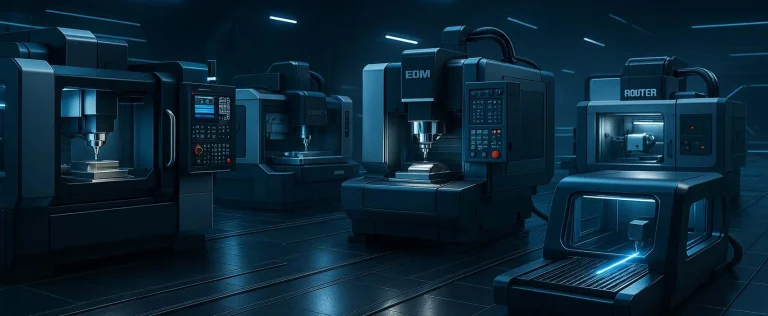
Electrical Machining Machines

Electrical Machining Machines use an electrical process to cut metal or solid materials, without any direct physical contact. This technology is very effective in creating complex, delicate shapes and can also work perfectly on heat-sensitive materials. It is mainly used in EDM and ECM methods.

Electrical Machining Machines: Complete Guide, Types, Advantages & Applications (2025)

Introduction

Electrical Machining MachinesIn today’s advanced manufacturing world, precision, complexity, and efficiency are non-negotiable. Traditional machining methods like milling, turning, and drilling are powerful, but they often struggle with extremely hard materials or intricate geometries. That’s where Electrical Machining Machines come in.

Unlike conventional machines that rely on mechanical cutting tools, these machines remove material using electrical energy—through sparks, chemical reactions, lasers, or plasma arcs. Among them, Electrical Discharge Machining (EDM) stands out as one of the most widely used and trusted processes for industries such as aerospace, automotive, mold & die, and medical manufacturing.

In this in-depth guide, we’ll explore the world of Electrical Machining Machines, with a special focus on:

By the end of this article, you’ll understand how these machines work, why they’re crucial for modern industries, and what the future holds for electrical machining.


What are Electrical Machining Machines?

Electrical Machining Machines are non-traditional machining systems that use electrical energy instead of physical cutting tools to remove material. They are particularly useful for machining:

  • Very hard materials like tungsten carbide, titanium, and hardened steel.

  • Intricate shapes that are difficult to achieve with milling or turning.

  • Precision components requiring micrometer-level accuracy.

Instead of cutting with a sharp tool, these machines rely on sparks, electric fields, chemical reactions, or concentrated energy beams to erode or remove material.


Types of Electrical Machining Processes

While EDM is the most popular, electrical machining covers several techniques:

  • EDM (Electrical Discharge Machining): Spark erosion process using controlled discharges.

  • ECM (Electrochemical Machining): Uses electrolysis to remove material without heat.

  • EBM (Electron Beam Machining): A focused electron beam melts material at high precision.

  • LBM (Laser Beam Machining): Uses a laser to melt and vaporize metals.

  • PAM (Plasma Arc Machining): High-energy plasma jet cuts through metals efficiently.

👉 For this article, we’ll focus mainly on EDM and its CNC variants, as they dominate the industry today.


Electrical Discharge Machining (EDM) – The Core Technology

EDM, also known as spark erosion, removes material by generating tiny sparks between the workpiece and an electrode, submerged in a dielectric fluid. Each spark melts and vaporizes a tiny part of the material, creating a precise shape without mechanical force.

Key Benefits of EDM:

  • Can machine extremely hard materials.

  • Creates complex and delicate shapes with ease.

  • Produces smooth surface finishes.

  • No direct contact = no mechanical stress on the workpiece.

Common Limitations:

  • Only conductive materials can be machined.

  • Slower than traditional milling or turning.

  • Higher machine cost and operational expenses.


EDM Spark Erosion Machine

An EDM Spark Erosion Machine is the most common type of EDM. It uses spark discharges between a tool electrode and the workpiece to erode material.

How It Works:

  1. The workpiece and electrode are submerged in dielectric fluid.

  2. Voltage is applied, creating controlled sparks.

  3. Each spark melts a tiny portion of material.

  4. The dielectric fluid flushes away debris.

Applications:

  • Mold and die manufacturing.

  • Hard tool steels.

  • Aerospace components.

  • Medical equipment.

This machine is ideal for creating intricate cavities, fine details, and precision parts that traditional tools cannot achieve.


CNC EDM (Electrical Discharge Machine)

The CNC EDM Machine is the computer-controlled version of EDM. By combining spark erosion with CNC automation, manufacturers gain accuracy, repeatability, and reduced human error.

Advantages of CNC EDM:

  • Fully automated machining process.

  • Higher precision with tight tolerances.

  • Ability to replicate complex designs consistently.

  • Reduced manual setup time.

Applications:

  • Automotive molds and dies.

  • Aerospace turbine blades.

  • Precision engineering industries.

CNC EDM has become a go-to choice for companies that require high productivity and consistent quality.


CNC Wire EDM (Wire-Cut EDM)

CNC Wire EDM, also called Wire-Cut EDM, is a specialized EDM process where a thin wire electrode continuously cuts through the material.

How It Works:

  • A brass wire (usually 0.1–0.3 mm thick) acts as the electrode.

  • The wire cuts through the material while submerged in dielectric fluid.

  • The process achieves extremely fine accuracy and smooth finishes.

Benefits:

  • Can cut intricate contours and complex geometries.

  • Produces very tight tolerances (±0.002 mm).

  • Minimal material stress and burr-free cutting.

Applications:

  • Aerospace precision parts.

  • Medical implants and surgical tools.

  • Electronic components.

  • Defense applications.


CNC Spark Erosion Machine

The CNC Spark Erosion Machine combines the spark erosion process with advanced CNC technology. It offers all the advantages of traditional EDM but with the precision, automation, and repeatability of CNC.

Why Industries Prefer CNC Spark Erosion:

  • Complex cavity cutting with accuracy.

  • Automated multi-axis capability.

  • Faster production cycles.

  • Lower dependence on operator skill.

This makes it a critical machine for industries that demand efficiency and precision simultaneously.


Comparison: EDM vs ECM vs Laser vs Plasma

ProcessWorking PrincipleMaterial SuitabilityAccuracyKey AdvantagesLimitations
EDMSpark erosionConductive materials only±0.002 mmPrecision, complex shapesSlow, costly
ECMElectrolysisConductive materials±0.01 mmNo heat damageLimited materials
LaserLaser beam meltingMetals & non-metals±0.02 mmHigh speed, flexibleExpensive
PlasmaPlasma arc cuttingMetals±0.1 mmFast for thick metalsRougher finish

Applications of Electrical Machining Machines

Electrical machining is vital across industries:

  • Aerospace: Turbine blades, fuel injector nozzles.

  • Automotive: Molds, dies, precision engine parts.

  • Medical: Surgical instruments, implants.

  • Electronics: Micro-components, connectors.

  • Tool & Die Industry: Injection molds, stamping dies.


Advantages of Electrical Machining

  • Precision cutting of complex shapes.

  • Ability to machine hardened steels and exotic alloys.

  • High-quality surface finishes.

  • Minimal tool wear.

  • Reduced mechanical stress on parts.


Limitations of Electrical Machining

  • Conductive materials only (for EDM/ECM).

  • High machine and maintenance costs.

  • Slower compared to milling/turning.

  • Requires skilled operators and careful monitoring.


Future Trends in Electrical Machining Machines

  • AI-driven EDM: Smart machines with adaptive control.

  • Hybrid Manufacturing: Combining EDM with additive processes.

  • Nano-precision machining: Ultra-fine tolerances for microelectronics.

  • Green EDM: Environmentally friendly dielectric fluids and processes.

Conclusion

Electrical Machining Machines represent a significant leap in manufacturing, offering solutions where conventional methods fall short. From EDM Spark Erosion Machines to CNC Wire EDM and CNC Spark Erosion Machines, industries now have the tools to achieve unmatched precision, complex geometries, and high-quality finishes.

As technology advances, these machines will only become smarter, faster, and more eco-friendly. For industries looking to stay competitive, investing in electrical machining technology is no longer optional—it’s essential.

👉 Explore More Insights on My CNC Line Blog

📚 FAQs About Electrical Machining Machines

Q No Question Answer
Q1 What is an EDM machine used for? EDM machines are used for precision cutting, mold making, and machining hard materials.
Q2 What is spark erosion? Spark erosion is another name for EDM, where sparks remove material from the workpiece.
Q3 What is the difference between EDM and ECM? EDM uses sparks (thermal process), while ECM uses electrolysis (chemical process).
Q4 Can EDM cut non-conductive materials? No, EDM only works on conductive materials.
Q5 What industries use EDM machines? Aerospace, automotive, medical, electronics, and mold & die industries.
Q6 How accurate is Wire EDM? Wire EDM can achieve tolerances of ±0.002 mm.
Q7 Is EDM better than laser cutting? EDM is more precise, while laser is faster but less accurate for fine details.
Q8 Does EDM damage material properties? No, since there’s no mechanical stress, material integrity is preserved.
Q9 What materials can EDM cut? Steel, tungsten carbide, titanium, aluminum, and other conductive metals.
Q10 What is the main disadvantage of EDM? It is relatively slow compared to traditional machining.
Q11 Why use dielectric fluid in EDM? It cools the process, removes debris, and controls spark discharge.
Q12 What is Wire EDM mainly used for? Cutting intricate shapes, contours, and precision parts.
Q13 Can EDM machine hardened steel? Yes, EDM is perfect for machining hardened and tough alloys.
Q14 Is EDM expensive to run? Yes, due to higher power, dielectric fluid, and maintenance costs.
Q15 What is a CNC EDM machine? A computer-controlled EDM machine offering automation and accuracy.
Q16 How does EDM compare with milling? Milling is faster for bulk removal, EDM is better for precision cavities.
Q17 What is an EDM Spark Erosion Machine? A machine that removes material using controlled spark erosion.
Q18 How long does EDM machining take? It depends on material hardness, thickness, and complexity.
Q19 Can EDM create very small holes? Yes, EDM hole drilling can produce micro-sized holes.
Q20 Is EDM environmentally friendly? Traditional EDM uses oils, but modern EDM is shifting toward eco-friendly fluids.